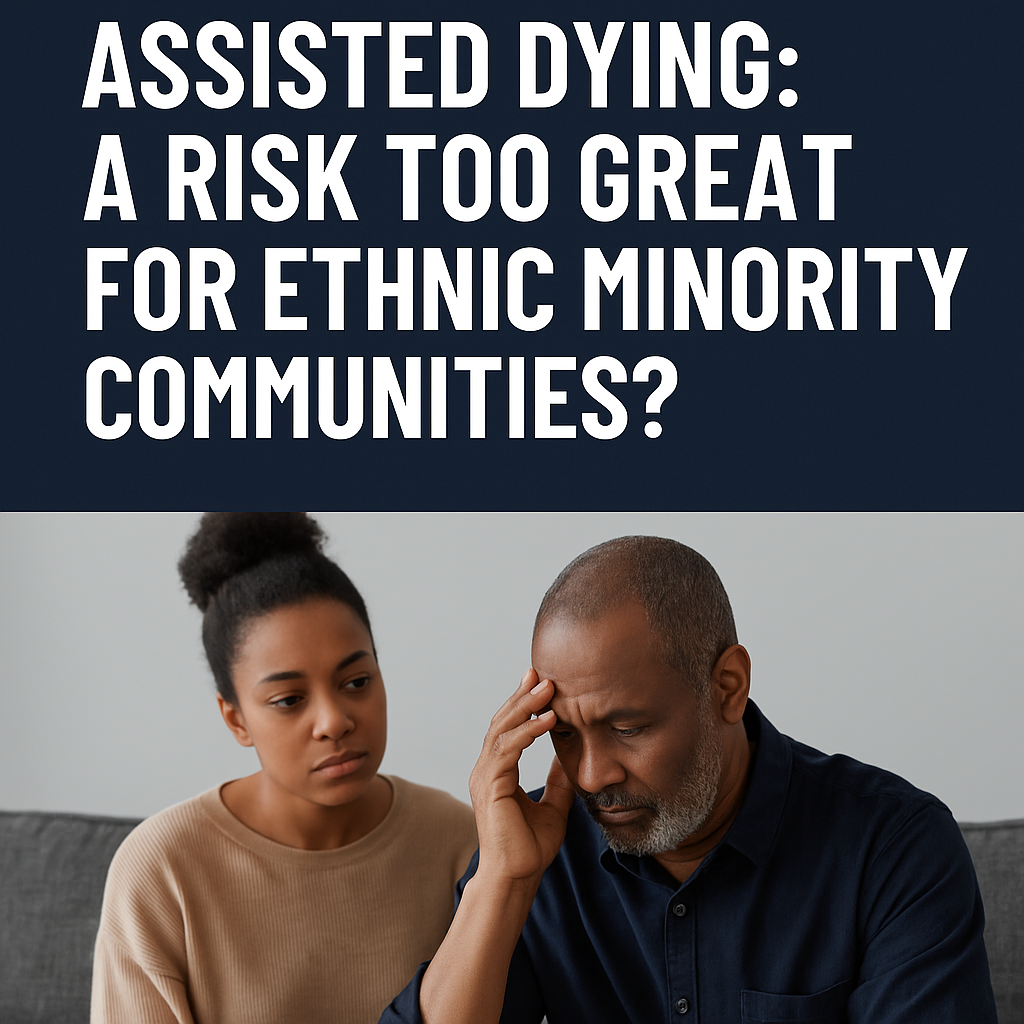
Assisted Dying: A Risk Too Great for Ethnic Minority Communities?
The debate around assisted dying often focuses on individual autonomy, dignity, and compassion for those facing terminal illness or unbearable suffering. While these are critical considerations, the implications for ethnic minority communities are far more complex—and potentially dangerous.
Across the UK, ethnic minorities—particularly Black, Asian, and other marginalized groups—have long faced systemic inequities across institutions. In the criminal justice system, for example, research consistently shows that Black individuals are more likely to receive harsher sentences than their White counterparts for similar offenses, even after accounting for background, socioeconomic status, and prior history.
These disparities aren’t isolated. They extend deeply into healthcare, social services, and welfare systems, where unconscious bias and structural racism shape both access and outcomes. In such a context, introducing assisted dying legislation without robust protections could have serious, unintended consequences for minority communities.
Could individuals from ethnic minority backgrounds, already receiving lower-quality care or treated as burdens on overstretched systems, feel pressured—explicitly or implicitly—toward choosing assisted dying? Might society’s historically skewed perceptions of whose lives are most “valuable” influence the options presented to patients? Could assisted dying policies become another avenue through which lives deemed “less worthy” are quietly deprioritized?
These are not hypothetical fears. They are rooted in lived experiences and backed by troubling patterns across public services.
Without strong, transparent, and culturally competent safeguards, assisted dying risks deepening existing inequalities rather than promoting genuine choice for all. For communities that already struggle to be seen and heard within healthcare and policy conversations, the stakes are too high to ignore.
Before legislating assisted dying, we must first confront—and dismantle—the systemic disparities embedded in our healthcare, legal, and welfare systems. Only then can we ensure that end-of-life decisions are truly free, fair, and equitable. Until such equity is a reality, assisted dying may carry risks that marginalized communities cannot afford to bear.